4 Radiocarbon in Central Andean archaeology
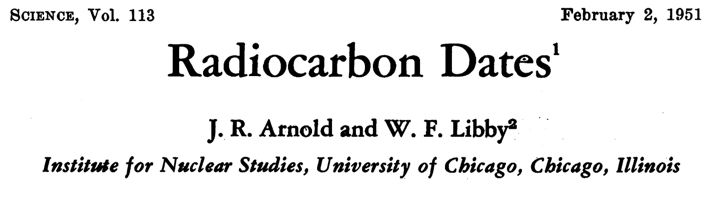
\(^{14}C\) dates from 14 Central Andean samples (of which 12 were archaeological, provided primarily by Junius Bird but also by George Kubler and Donald Collier) appeared in print as early as 1951, included amongst the first samples of unknown age dated by the radiocarbon method (Arnold and Libby 1951:119–120; Bird 1951). Even as these were first published (and re-published in Spanish shortly thereafter [Bird 1952]), Bird was already attempting to use the stratigraphic relationships between these dates to constrain the possible dates, and grappling with how to interpret the probabilistic nature of the data (e.g., Bird 1951: Fig. 1 and p47). Construction of macro-scale chronologies (e.g., Bird 1951:Table 2) for the region was the primary concern. (Contreras 2023:3)
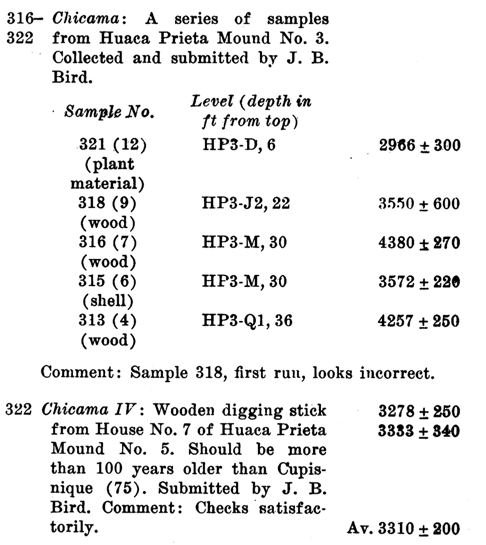
The point of these samples was not so much to establish age as to use samples of known antiquity to demonstrate that the radiocarbon method of age estimation worked!
Renfrew (1973) and subsequently Taylor (1995) and Bayliss (2009) posit three distinct revolutionary impacts of radiocarbon dating on archaeology: the introduction of a reliable method of absolute dating, calibration that could relate those dates directly to calendar years, and methodological improvements (atomic mass spectroscopy [AMS]) that vastly increased the numbers of dates produced. (Contreras 2023:3)
- Detectable in the Central Andes!
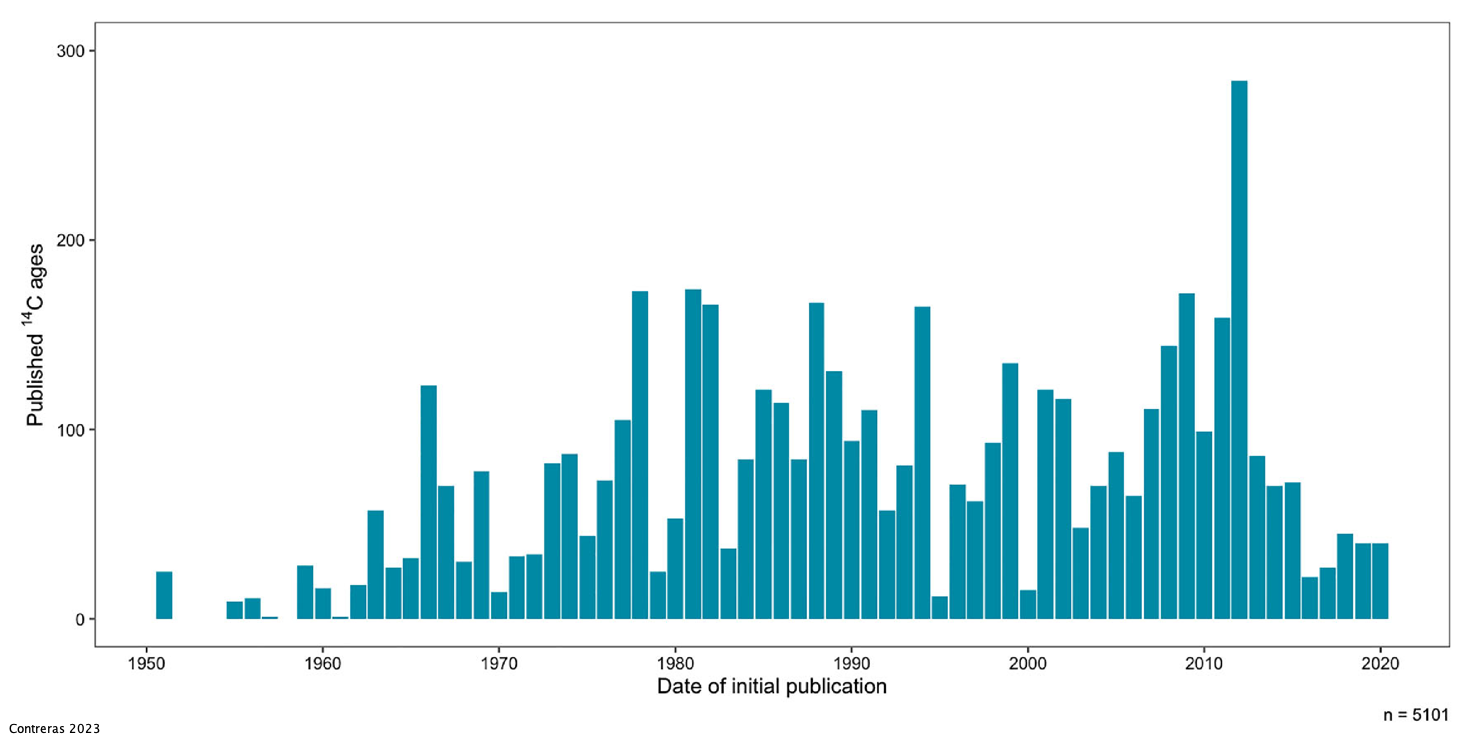
Figure 4.1: Publication of \(^{14}C\) dates for the Central Andes, 1951–2020. While post-1994 dates are certainly undercounted, the overall pattern remains a coherent one of adoption, incremental increase until a jump in the late 1970s, and then relative stability until a second increase in the early twenty-first century. (Contreras 2022)