Chronology, Continuity, and Hiatus: Radiocarbon Dating of Monumental Mudbrick Architecture in Peru’s Chicama Valley
Jan 1, 2026· ,,,,·
0 min read
,,,,·
0 min read
Benjamin R. Vining
Daniel A. Contreras
Augusto Bazán Pérez
Arianna Garvin Suero
Yuriko García Ortiz
María López Rojas
Abstract
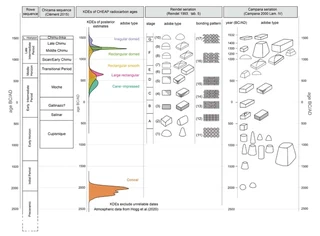
Cultural sequences often rely on relative or typological chronological techniques, even as radiometric methods producing absolute ages become increasingly common. This reflects the perception that typological approaches are faster and sufficiently reliable, whereas radiometric precision demands greater time and financial investment. Here, we present a strategy for obtaining radiocarbon ages from monumental mudbrick structures (huacas), reporting 72 radiocarbon dates spanning 4000 – 600 CAL B.P. from 13 sites in Peru’s Chicama Valley. By capitalizing on non-archaeological disturbances, we can efficiently produce AMS 14C determinations and evaluate the chronological assumptions of typologies. Results show that existing relative chronologies are broadly sound but poorly suited to resolving fine-grained diachronic change. Our results suggest monument building in Chicama occurred as relatively short pulses of intensive activity separated by long hiatuses. This study shows the potential of an underutilized material — mudbrick — to yield valuable chronological, ecological, and cultural information while minimally disturbing archaeological resources.
Type
Publication
Journal of Field Archaeology
Authors

Authors
Associate Professor of Anthropology
Daniel Contreras is an associate professor of Anthropology at the University of Florida. He is an anthropological archaeologist whose research interests focus on past human-environment interactions over long timescales.